Bainbridge–Ropers syndrome is a very rare genetic disorder characterized by abnormalities including severe psychomotor development, feeding problems, severe postnatal growth delays, intellectual disabilities, and skeletal abnormalities.
Signs and symptoms
Morphological features of this syndrome include:[citation needed]
- Arched eyebrows
- Anteverted nares
- Ulnar deviation of the hands
- Microcephaly
- Skeletal abnormalities, such as a "barrel chest", extremely high arched palate
- Crowded teeth
- Hypertelorism (wide-set eyes)
- Scoliosis
Genetics
This condition is caused by a mutation in the ASXL3 gene, which is considered a de novo mutation.[citation needed]
Genetic changes that are described as de novo (new) mutations can be either hereditary or somatic. In some cases, the mutation occurs in a person's egg or sperm cell but is not present in any of the person's other cells. In other cases, the mutation occurs in the fertilized egg shortly after the egg and sperm cells unite. (It is often impossible to tell exactly when a de novo mutation happened.) As the fertilized egg divides, each resulting cell in the growing embryo will have the mutation. De novo mutations may explain genetic disorders in which an affected child has a mutation in every cell in the body but the parents do not, and there is no family history of the disorder.[1]
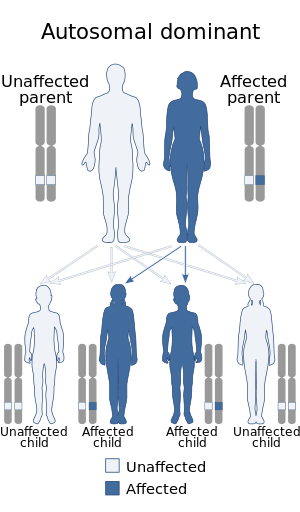
This condition is inherited in an autosomal dominant fashion.[citation needed]
Mutations in the Additional Sex Combs Like 3 (ASXL3) gene on the long arm of chromosome 18 (18q12.1) have been associated with this condition.[2]
Diagnosis
Diagnosis can only be made by genetic testing.[citation needed]
Differential diagnosis
Bohring–Opitz syndrome
Treatment
There is no currently known treatment or cure for this condition. However, the symptoms can be treated.[citation needed]
History
This condition was first described by Bainbridge et al in 2013.[2]