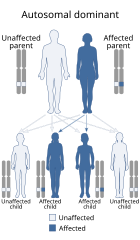
Shprintzen–Goldberg syndrome is a multiple anomaly syndrome that has craniosynostosis, multiple abdominal hernias, cognitive impairment, and other skeletal malformations as key features. Several reports have linked the syndrome to a mutation in the FBN1 gene, but these cases do not resemble those initially described in the medical literature in 1982 by Shprintzen and Goldberg,[2] and Greally et al. in 1998 failed to find a causal link to FBN1.[3] At this time, the cause of Shprintzen–Goldberg syndrome has been identified as a mutation in the gene SKI located on chromosome 1 at the p36 locus. The syndrome is rare with fewer than 50 cases described in the medical literature to date.