Woodhouse–Sakati syndrome,[1] is a rare autosomal recessive[2] multisystem disorder which causes malformations throughout the body, and deficiencies affecting the endocrine system.[3]
Presentation
The syndrome is characterized by alopecia, hypogonadism, hypothyroidism, hearing loss, intellectual disability and diabetes mellitus. Electrocardiogram anomalies have also been reported.[2]
Genetics
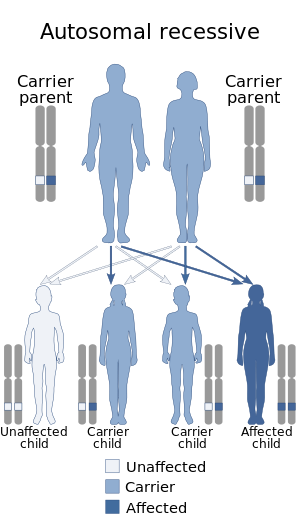
Mutations in the C2orf37 gene, located at human chromosome 2q22.3-q35, are believed to be a cause of Woodhouse–Sakati syndrome.[1][4] The disorder is inherited in an autosomal recessive manner.[2] This means the defective gene responsible for the disorder is located on an autosome (chromosome 2 is an autosome), and two copies of the defective gene (one inherited from each parent) are required in order to be born with the disorder. The parents of an individual with an autosomal recessive disorder both carry one copy of the defective gene, but usually do not experience any signs or symptoms of the disorder.[citation needed]
Diagnosis
Like with most other NBIA diseases, a T2-sequence MRI is used to detect iron accumulation in the brain. A blood test can also be used to detect low insulin-like growth factor 1 levels.
Diagnosis of Woodhouse-Sakati syndrome requires genetic testing of the DCAF17 gene, which scans for two specific gene changes. The testing begins with sequence analysis, and if no changes are found, continues with deletion and duplication analysis.